The Da Vinci Paradox

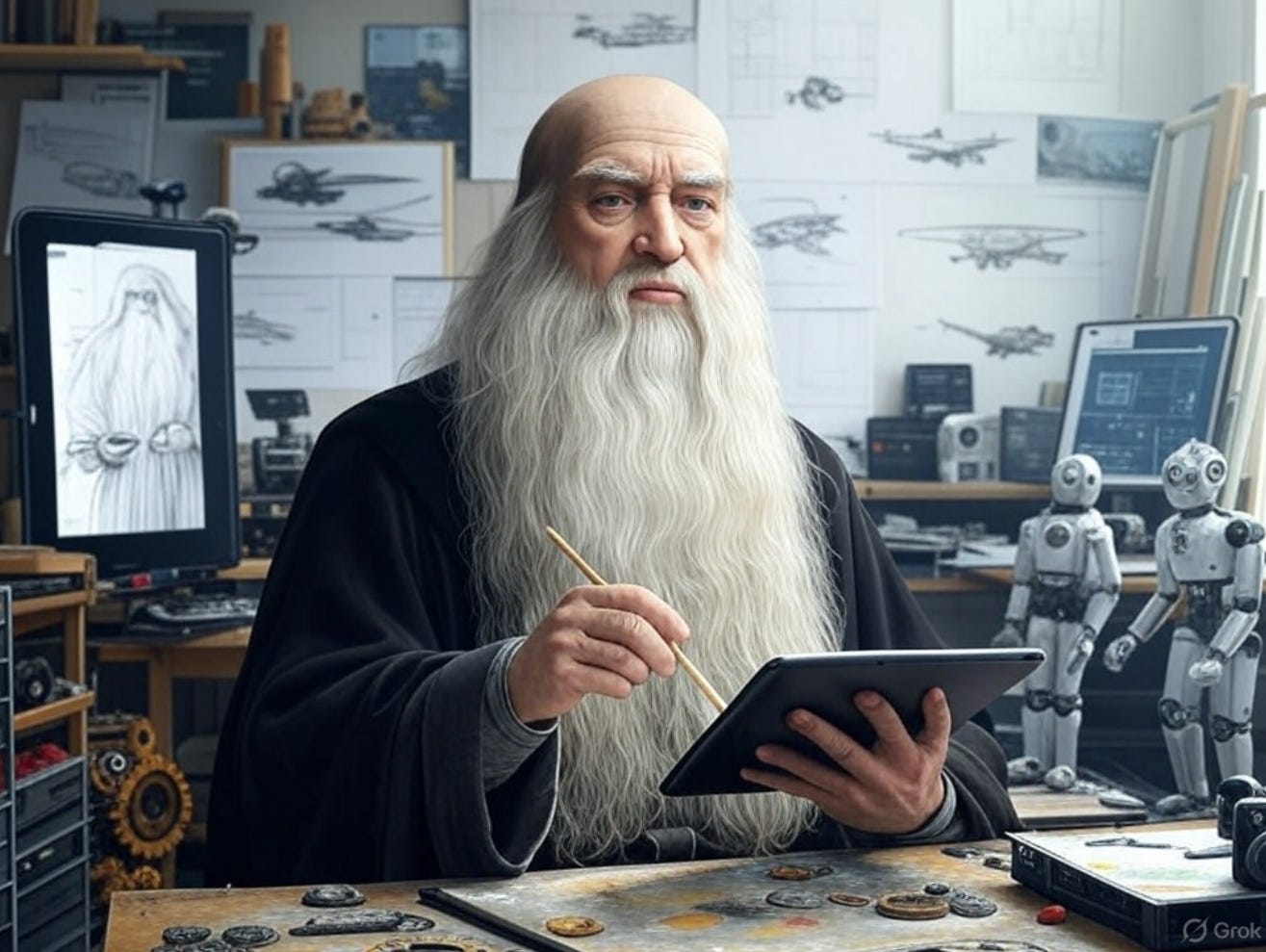
Renaissance Mind in the AI Age
I've always dreamed of living like Leonardo da Vinci—skipping between inventions and art, sketching a flying machine one day, painting a mystery the next, ideas spilling out in a quiet workshop. Part of it's my ADHD, that restless itch to chase every spark like he did. With AI—Cursor, Claude, ChatGPT O1, a flood of chances—I'm almost there. My mind is buzzing: prototyping a domain specific programming language backed by LLVM- something which would have taken a team to pull off a few years back, a memory allocator that beat malloc and even TCMalloc in a day; a Telegram bot sharing edge AI papers with its subscribers with AI summarisation features, a little ML compiler showcasing creation of executable binaries starting from pytorch specification of deep learning models.
For a moment, I'm him—a modern Leonardo da Vinci, hands full of half-made wonders. But his world was slow, years to breathe and build. Mine's a rush—months, days, hours—and these dreams fade fast, buried in noise I can't outrun.
Sketches That Fade
My workshop's alive with my tries. SimpLang (github.com/maderix/SimpLang) is my flying machine—a programming language for DSPs and NPUs in nascent stages, a shot at something like CUDA but for edge devices, sparked by Claude and 3-4 weeks of effort.
3 AM. Eyes burning. Screen glare etching my retinas. The SimpLang compiler just converted a simple program into executable code and my heart races. Holy shit, it works. I'm giddy, manic, pacing my apartment, talking to myself like a madman. "Do you see this? Do you fucking see this?" I ask my empty room. This thing I made with my hands—it understands. For twenty electric minutes, I'm a god.
The memory allocator (github.com/maderix/memory-allocator)—fast and simple, outran malloc in a day—gave me a rush like nailing a gear design. My benchmarks ran and I literally screamed. Numbers don't lie. Mine's faster—not by a little—by enough to matter. I couldn't sleep, kept running tests, tinkering, watching it soar. Sent screenshots to friends who don't care, who couldn't possibly understand why this matters so goddamn much.
The Telegram bot (github.com/maderix/edge-ai-papers-bot) is my notebook to sift my AI papers madness, pulling edge AI papers, tossing summaries when requested, answering when it can—rough but real. When it first filtered signal from noise and delivered that perfect paper I'd have missed? I felt like I'd built a tiny, loyal creature. Something alive. Something mine.
The ML compiler (github.com/maderix/simple_ml_compiler)—a bridge between my day job working in edgeAI —came from a long standing urge to dig deeper while keeping things simple. When the first model(a simple MNIST digit classifier) compiled cleanly to machine code, I sat staring, stunned at that automaton which just worked . This used to be dark magic, hidden behind corporate walls. Now it's mine to play with, to fly like that paper aeroplane as Da Vinci would have floated from his rooftop.
These are my sketches, born from that itch to jump around and make stuff. AI's my helper, turning sparks into something I can hold. But they don't last.
The Crash
Morning light. Coffee gone cold. SimpLang's got weird errors I missed in my 3 AM euphoria. Code is a clusterfuck of boilerplate hell. Embarrassing, obvious mismatches. Amateur hour. What was I thinking? The CUDA dream suddenly looks like Mount Everest from sea level. I scroll through the code—my beautiful creation from last night—and see all its flaws, its naivety, its impossible distance from what I imagined.
The allocator's quick, but raw and works only for special cases where the regular allocators fail - in highly concurrent usecases with hundreds of thread vying to allocate and free all sizes of memory blocks at random intervals. I made it dance for my specific music; you might put it in the wild and it stumbles, crashes, burns sometimes slower than regular malloc . Pathetic. I drive the design and experiments, the LLM churns and prints code like no tomorrow, but we're both faking it. We don't truly understand memory management at the hardware level. We're children playing with matches dreaming of building that rotating tank canon which Da Vinci illustrated in his notebook in a fever dream.
The telegram bot stumbles sometimes, it's running on a puny raspberry Pi and sometimes misses on delivering timely AI papers like an errant newspaper boy. I get message about failures to find papers and deliver. I fix one thing, LLM breaks another. It feels like patching a leaky boat while drifting further from shore.
The compiler's just for me, half-done. Was I seriously thinking I could build something competitive with PyTorch? with Triton? With TensorFlow? With the work of hundreds of PhDs and engineers? Delusional! A naivete of someone with power - an overconfident Thanos with only half infinity stones.
Da Vinci had years to finish; I've got days. My workshop's full of half-built things—wings that sag, gears that stick—fading before I can catch them. Each one could be something if I just had time, focus, discipline. If I just wasn't me.
The Noise That Buries
It's not just my stuff. The world's loud now—AI's let everyone loose. Code pours out, posts pile up, bots talk over each other. My Telegram bot tries to sift good AI papers from the mess, but the mess wins. I used to find gold on X or GitHub—a fix, a post that clicked. Now it's junk everywhere. The good's there—last week, bunch of ideas on LLMs which seemed truly novel—but they are often lost in the racket of wrapper startups promising to make the next Frankenstein's coder - the fever dream of CEOs and the AI renaissance generation.
My phone buzzes constantly. Notifications from twenty different platforms. Everyone's a creator now, everyone's building, sharing, pushing. The volume crushes me. I can't keep up. Can't sort signal from noise anymore. Miss critical updates for my own projects because they're drowning in the feed.
I'm in it, too. SimpLang tweaks, bot messages—they're my work, but noise to others. Da Vinci's sketches stood alone; mine fight to breathe in a hurricane of content. Every line I write feels simultaneously revolutionary and utterly redundant. Someone's probably built it already, better, faster, with more followers.
Dreams Too Big for Hours
I thought AI would give me da Vinci's freedom—time to chase big ideas. It did, at first. Looms made cloth worth weaving; AI makes my stuff worth trying. SimpLang could change hardware, the allocator could speed things, the bot could point the way. But starting's cheap—finishing's tough.
Da Vinci had years; I've got hours stolen between sleep and work . My cat calls for playtime. With some guilt I get up and play with him. SimpLang's a sketch while I mess with the allocator. The allocator sits cold while I debug the bot. The bot waits while I tinker with the compiler. The compiler languishes while I circle back to SimpLang with fresh ideas. My attention fractures, splinters, shatters. My time's not growing—it's splitting, too much for one pair of hands, one tired brain.
I keep adding features when I can't even finish the core. Keep starting new branches when the trunk is barely standing. Keep imagining version 5.0 when 0.1 is still buggy. The canvas expands faster than I can paint. The notebooks are no match for my thoughts now made even more concrete with AI. I’ve sunk so much into subscriptions but I can’t stop, the ideas need to be brought to life.
A Glimmer in the Rush
There's still something. The allocator's speed made me grin—not the manic 3 AM grin, but the quiet, satisfied smile of having made something real. Something that does what it's supposed to do, even if imperfectly. The benchmark doesn't lie. It's faster. That's true. That's mine.
SimpLang's got a hum I can hear when I stop rushing, when I let it be what it is instead of what I dreamed. It's a sketch, yes, but da Vinci's sketches weren't finished either. They were ideas, possibilities, attempts. Mine is too.
The bot gets a "thanks" when it hits a good paper. A friend, found something useful through my creation. That's real. That matters, even if it's small.
The ML compiler shows me the rawness of ML models I didn't see. Makes the magic less magical, more mechanical. That understanding is mine now, even if the project never reaches 1.0.
Last week, Something I heard at my day job fit SimpLang like a key—validating my idea and my hunch of the need of this language. Da Vinci would be proud. A stranger's idea melded perfectly with mine. For a moment, I wasn't alone in vision. There was a conversation happening, ideas building on ideas. Even though it’s all in the zeitgeist and I’m just a part of it.
Acceptance in Chaos
I won't quit. SimpLang's too wild, the allocator's too fast even if it’s incomplete, the bot's too alive if nothing else it tells me the power issues at my place (the Pi reboots upon evey power reset ) But I've stopped fighting the chaos. Started working with it instead.
My projects aren't failures because they're unfinished. They're experiments, learning, steps. Da Vinci's notebooks weren't filled with completed masterpieces—they were filled with questions, attempts, half-formed brilliance. Mine too.
I've stopped comparing my beginning to someone else's middle. Stopped feeling like an impostor because I don't understand every system call or memory allocation strategy. Started seeing my ADHD as my engine rather than my enemy.
The noise is still there. The time still short. The dreams still too big. But now I see my half-built machines differently. They're not sad reminders of what I couldn't finish—they're evidence of what I started. What I figured out. What I made real, even briefly.
Da Vinci had slow years to dream; I've got a noisy corner and a clock that won't wait. AI handed me a canvas of ideas, then tore it with its own speed. My machines creak—half-made, fragile—while the noise rises. I'm reaching for his life, sparks flying, hoping a few true notes break through before they're gone.
And yet I still need to get into AI assisted game development, that may be a gold mine! 😀
...and there I go again, chasing the next spark before the current flame is even lit. But that's okay. That's me. That's how I fly. One day , my work will make to the memories of future AIs, a fragment of Da Vinci honored in my creations.